


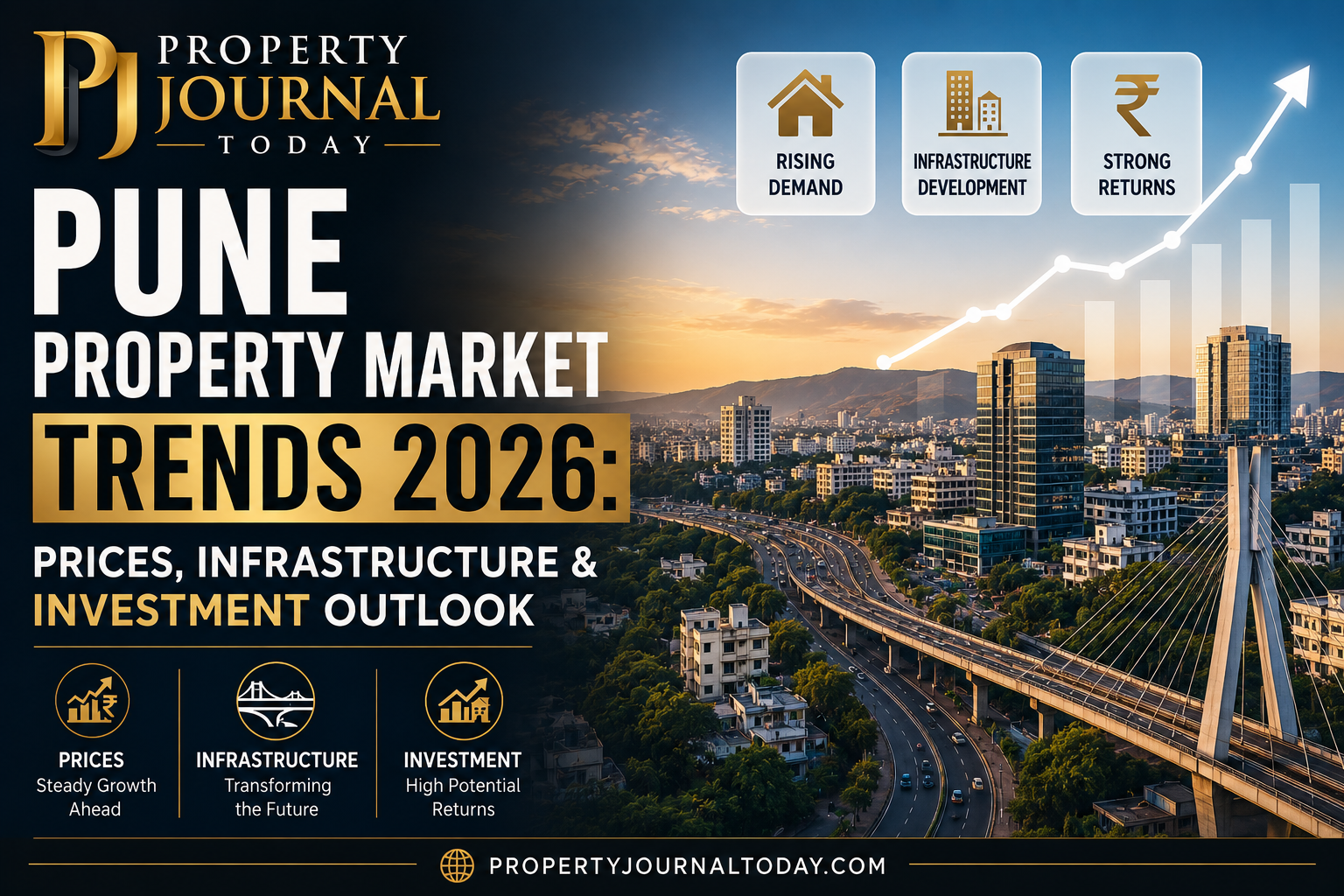
Pune's real estate market in 2026 is moving through a maturing, demand-led growth phase rather than a speculative boom. Residential prices are appreciating gradually (broadly 5–10% a year depending on the micro-market), end-user demand remains firm, and premium housing is the fastest-growing segment. Infrastructure — led by the Hinjewadi–Shivajinagar Metro Line 3 and the Pune Ring Road — is the single biggest driver of where value is being created.
📊 Key Statistics Summary
- ₹5,016 per sq ft — Pune's average residential price in 2025, up roughly 5% year-on-year (Hindustan Times; corroborated by JLL Research at ~6% capital-value growth across key micro-markets).
- ~50,800 units — residential sales in 2025, a marginal ~3% dip as buyers turned selective.
- 14,527 property registrations in January 2026, down ~17% year-on-year from 17,449 in January 2025, with stamp-duty collection of about ₹609 crore (IGR Maharashtra) — followed by a month-on-month recovery from December 2025.
- 9.9 million sq ft — Pune's record office gross leasing volume in 2025, a strong demand signal for residential micro-markets.
- 3–4 BHK homes rose from ~20% to ~29% of new launches in 2025; the ₹1–2 crore segment has seen roughly 300% growth in units sold since 2021 — clear evidence of premiumisation.
Table of Contents
- Introduction
- Pune Property Market 2026: Current Overview
- Latest Developments & Infrastructure
- Expert Analysis
- Benefits and Opportunities
- Risks and Challenges
- Impact on Homebuyers
- Impact on Investors
- Future Outlook
- Key Takeaways
- Conclusion
- Frequently Asked Questions
1. Introduction
For two decades, Pune has steadily shed its image as a quiet pensioners' and education town and matured into one of India's most resilient real estate markets. Backed by a deep IT ecosystem in Hinjewadi, a strong manufacturing base around Chakan and Talegaon, a young salaried workforce, and a quality of life that compares favourably with Mumbai at a fraction of the price, the city has consistently drawn homebuyers, investors and NRIs.
As 2026 unfolds, the Pune property market trends point to a market in consolidation: prices firming rather than spiking, demand driven by genuine end-users rather than speculators, and value increasingly concentrated around employment hubs and new infrastructure. This article breaks down the latest data, the developments reshaping the map, and what it all means for buyers, investors and professionals.

2. Pune Property Market 2026: Current Overview
The headline story is stability with selective growth. Pune's average residential price reached roughly ₹5,016 per sq ft in 2025, up about 5% year-on-year, while research houses peg capital-value growth across key micro-markets at around 6% annually.
Volumes tell a more nuanced story. The city recorded about 50,800 residential sales in 2025, a marginal ~3% dip as rising prices made buyers more selective. Early 2026 opened on a soft note: January 2026 registrations fell ~17% year-on-year to 14,527 units, with stamp-duty collections down ~5% to about ₹609 crore, according to Maharashtra's Inspector General of Registration (IGR). Importantly, the market then recovered on a month-on-month basis from December 2025, suggesting a seasonal dip rather than a structural decline.
Three structural shifts define the current market:
- Premiumisation. Larger, higher-value homes are leading demand. 3–4 BHK units climbed from about 20% to 29% of new launches in 2025, and the ₹1–2 crore segment has grown roughly 300% in units sold since 2021.
- End-user dominance. Even when sales volumes softened, prices held firm — a hallmark of a market driven by people buying to live, not to flip.
- Commercial strength feeding residential demand. Pune's office market hit a record 9.9 million sq ft of gross leasing in 2025. More offices typically mean more housing demand in the surrounding corridors.
3. Latest Developments & Infrastructure
Infrastructure is the most influential force on Pune's 2026 property map. Three projects stand out.
Pune Metro Line 3 (Hinjewadi–Shivajinagar). This 23.2 km elevated corridor with 23 stations is India's first metro built under a public-private partnership (the New Metro Policy, 2017), executed by a Tata–Siemens joint venture at an estimated ₹8,313 crore. As of mid-2026, Phase 1 — a 13.3 km, 12-station stretch from Maan (Hinjewadi) to the RK Laxman Museum — was targeted for civil completion by 30 June 2026, with PMRDA indicating a phased passenger launch around mid-July (the formal inauguration date was still to be confirmed at the time of writing). The extension to District Court (Shivajinagar) is targeted for late August 2026, and the full corridor by December 2026. Once operational, travel time between Shivajinagar and Hinjewadi is expected to fall to around 45 minutes from roughly 90 minutes today — a direct boost to property demand along the Hinjewadi–Wakad–Balewadi belt.

Pune Ring Road. A roughly 170+ km circular corridor (MSRDC outer alignment plus PMRDA inner ring) estimated at around ₹17,000+ crore is targeted for completion by December 2026, connecting six national highways and dozens of peripheral villages. Land acquisition on the outer alignment has reported strong progress. The Ring Road is unlocking peripheral corridors such as Talegaon, Chakan, Wagholi, Moshi and Kesnand, where affordability meets future connectivity.
Purandar International Airport. The proposed greenfield airport (Chhatrapati Sambhaji Raje International Airport) is a longer-horizon catalyst. By early 2026, landowner consent in the core villages had reportedly reached the 94–96% range, removing a major hurdle, with construction expected to take three to three-and-a-half years once it begins. Even at the announcement-and-acquisition stage, it is already lifting investor interest in the Saswad, Wagholi–Kesnand and south-east Pune belts.
4. Expert Analysis
Read at the city level, Pune looks merely "stable." Read correctly — as a collection of distinct micro-markets — it is far more interesting. The consistent theme across analyst commentary in 2026 is that Pune's growth is infrastructure-led and jobs-anchored, not hype-driven.
A useful framing for 2026:
- West Pune (Baner, Balewadi, Wakad, Hinjewadi): premium pricing, driven by proximity to the Hinjewadi IT hub and lifestyle infrastructure; the prime beneficiary of Metro Line 3.
- East Pune (Kharadi, Wagholi, Hadapsar): strong appreciation potential with relatively better entry values; supported by Kharadi's commercial growth and Ring Road connectivity.
- Peripheral corridors (Punawale, Ravet, Moshi, Chikhali, Charholi, Talegaon, Chakan): affordable entry points with the strongest long-term upside as Ring Road and metro feeders mature.
The professional's rule of thumb that recurs in 2026 commentary: follow jobs, not just infrastructure. Infrastructure drives sentiment; employment hubs drive durable demand. Avoid oversupplied micro-markets, and look at absorption rates rather than headline prices alone.
5. Benefits and Opportunities

- Healthy long-term appreciation. With prices expected to grow a moderate 5–10% annually depending on location, Pune rewards patience over speculation.
- Strong rental fundamentals. A constant influx of IT professionals and students keeps rental demand high; analysts cite residential yields around 3–5% and commercial yields around 7–9%.
- Infrastructure-led upside. Properties near operational metro stations and Ring Road nodes are already seeing accelerated appreciation.
- Relative affordability. Pune remains materially cheaper than Mumbai while offering comparable career opportunities — a key NRI and migrant draw.
- RERA transparency. MahaRERA gives buyers a verifiable record of a builder's track record and delivery timelines, reducing fraud risk.
6. Risks and Challenges
No market is one-directional, and a balanced view matters:
- Oversupply in some corridors can cap price appreciation where new launches outpace absorption.
- Infrastructure delays are a real risk — the Metro Line 3 timeline itself has slipped repeatedly, and project optimism should be discounted accordingly.
- Interest-rate sensitivity continues to influence buyer sentiment and EMIs.
- Rising transaction costs. Stamp duty (6%, or 5% for women buyers), a 1% registration fee, and a 1% metro cess in the Pune metro region add meaningfully to the total acquisition cost.
- Selective, not uniform, growth. Choosing the wrong micro-market — chasing brochures over fundamentals — can leave capital idle even in a "rising" city.
7. Impact on Homebuyers
For end-users, 2026 is a buyer-aware, not buyer-panicked, market. Key practical implications:
- Budget for the full cost, not just the ticket price. On a residential purchase in Pune, expect stamp duty of 6% (women buyers pay 5% with a 1% concession, subject to a 15-year resale condition), plus 1% registration (capped at ₹30,000) and a 1% metro cess. Ready reckoner (circle) rates — the government's minimum valuation benchmark — were revised upward in 2025–26 (the first hike in two years, averaging roughly 3.9% statewide, with PMC areas up 4–6% and PCMC up ~6.7%). For the 2026–27 revision, published reports vary, so verify the current rate for your specific locality on the official IGR Maharashtra e-ASR portal before budgeting.
- Buy near jobs and transit. Homes within reach of operational metro stations and major employment hubs offer the best combination of livability and resale.
- Insist on RERA registration. Check the project and builder directly on the MahaRERA portal for delivery history and timelines.
- Don't ignore resale inventory. In several corridors, the best value sits in the secondary market, not new launches.
8. Impact on Investors
For investors, Pune in 2026 is a long-hold, fundamentals-first market rather than a quick-flip play.
- Align to your goal. For rental income, established hubs near offices (Kharadi, Baner–Balewadi, Hinjewadi) work best. For capital appreciation, early entry into infrastructure-led corridors (Hinjewadi Phase 3, Ring Road nodes, Purandar-influence zones) offers the steepest upside — but over a 5-year-plus horizon.
- Commercial deserves a look. With record office leasing and yields around 7–9%, commercial and pre-leased assets are an under-discussed opportunity.
- Time the infrastructure curve. The window to enter before metro and Ring Road sections become fully operational is narrowing; once connectivity is live, entry prices typically reset higher.
- Underwrite on absorption, not hype. A rising price with weak demand is a red flag.
9. Future Outlook
Looking past 2026, Pune's trajectory hinges on continued infrastructure modernisation and the spread of employment beyond traditional IT clusters into manufacturing and logistics belts (Chakan, Talegaon, Ranjangaon). The likely path is steady, sustainable appreciation — mid-single to low-double-digit annual growth in the strongest corridors — rather than a boom-bust cycle.
The structural tailwinds are intact: a young workforce, deep office demand, improving connectivity, and RERA-backed transparency. The structural caution is equally clear: this is a selective market, and city-level averages will increasingly hide wide micro-market divergence.
10. Key Takeaways
- Pune's 2026 market is stable, end-user-driven and in consolidation — not a speculative boom.
- Prices are appreciating ~5–10% a year, concentrated around jobs and infrastructure.
- Metro Line 3, the Pune Ring Road and Purandar Airport are the decisive value drivers.
- Premium housing (3–4 BHK, ₹1 crore+) is the fastest-growing segment.
- Buy and invest on fundamentals and absorption, verify RERA and ready reckoner rates, and budget for full transaction costs.
11. Conclusion
Pune in 2026 offers something increasingly rare in Indian real estate: a large, liquid market growing on genuine demand rather than froth. The opportunity is real, but it is location-specific. The buyers and investors who win will be the ones who follow jobs and transit, verify everything through official channels, and think in years rather than months.
Stay updated with the latest real estate news, market insights, investment opportunities, and infrastructure developments across India only on Property Journal Today.
5. FAQs (FAQ Schema-ready)
Q1. What are the Pune property market trends in 2026? In 2026, Pune is in a stable, demand-led consolidation phase. Prices are appreciating gradually (roughly 5–10% a year depending on the micro-market), end-user demand is firm, premium 3–4 BHK housing is the fastest-growing segment, and infrastructure projects like Metro Line 3 and the Pune Ring Road are the main value drivers.
Q2. Will property prices in Pune increase in 2026? Most analysts expect moderate appreciation of about 5–10% annually, varying by location. Growth is backed by real end-user demand, rising construction costs and limited land in prime micro-markets — not speculation — so sharp spikes are unlikely.
Q3. Which are the best areas to invest in Pune in 2026? For rental income, established hubs such as Kharadi, Baner–Balewadi and Hinjewadi perform well. For capital appreciation, infrastructure-led corridors like Hinjewadi Phase 3, Wakad, Wagholi–Kesnand and Ring Road nodes (Moshi, Chikhali, Talegaon) offer strong long-term upside.
Q4. How will Pune Metro Line 3 affect property prices? The Hinjewadi–Shivajinagar Metro Line 3, with Phase 1 targeted for completion around mid-2026, is expected to cut Shivajinagar–Hinjewadi travel time to about 45 minutes from roughly 90 minutes. Properties near operational stations along the western corridor are already seeing accelerated demand and appreciation.
Q5. What stamp duty and charges apply when buying property in Pune in 2026? Buyers typically pay 6% stamp duty (5% for women buyers, with a 1% concession and a 15-year resale condition), a 1% registration fee (capped at ₹30,000), and a 1% metro cess in the Pune metro region. Always confirm the current ready reckoner rate for your locality on the official IGR Maharashtra e-ASR portal.
Q6. Is Pune a good market for NRIs in 2026? Yes. Pune combines relative affordability versus Mumbai, strong rental demand, and MahaRERA-backed transparency that lets NRIs verify a builder's track record and project delivery timeline before committing, reducing fraud risk.